 Blur NFT
Blur NFT bidding commits you to buying eligible items at your offered price
Blur NFT bidding lets sellers accept your collection offer for eligible NFTs at the price you authorize. You commit to the collection criteria and quantity, without selecting every individual item before purchase. A seller can complete a valid fill without asking you to approve the purchase again. Execution still requires sufficient bidding funds, valid authorization, and an order that remains available. The decision therefore starts with which items you would accept and how many you could acquire. The collection floor and competing bids help describe the market, while your signed terms determine the purchases the offer permits.
A collection bid authorizes purchases across its eligible items, so the acceptable quantity matters alongside the price per NFT.
Prepare a collection offer you would accept in full
Start with the intended collection, an acceptable price per NFT, and a quantity you would be willing to receive. Confirm the collection identity and eligibility before authorizing the offer.
Suppose you would accept any eligible item, and your bidding balance covers the proposed purchases. Review the offer scope, price, quantity, and expiration, then sign only if those terms match your intention. An active offer record shows the bid as outstanding; it does not guarantee a successful fill or establish that you own an NFT.
A change in quantity changes the commitment even when the price stays unchanged. A larger offer permits more purchases and leaves more quantity available after an initial fill. The purchase value equals the price per NFT multiplied by the quantity. The displayed floor and available bidding balance are changing inputs.
If a fill reduces your balance or the remaining quantity, review that remaining offer before adding another. If the collection becomes unacceptable at your price, cancel the unfilled commitment. A cancellation cannot reverse a purchase that settled first.
After a fill, check that the purchase record matches the NFTs you received and that the remaining bid matches your intention. Use these conditions to decide whether to leave the offer active:
- The offer covers the intended collection and acceptable eligibility criteria.
- The price remains acceptable for any item the offer permits.
- The remaining quantity fits the number of additional NFTs you would accept.
- The bidding balance covers the purchases you intend to fund.
- The expiration and cancellation status match how long you want the offer available.
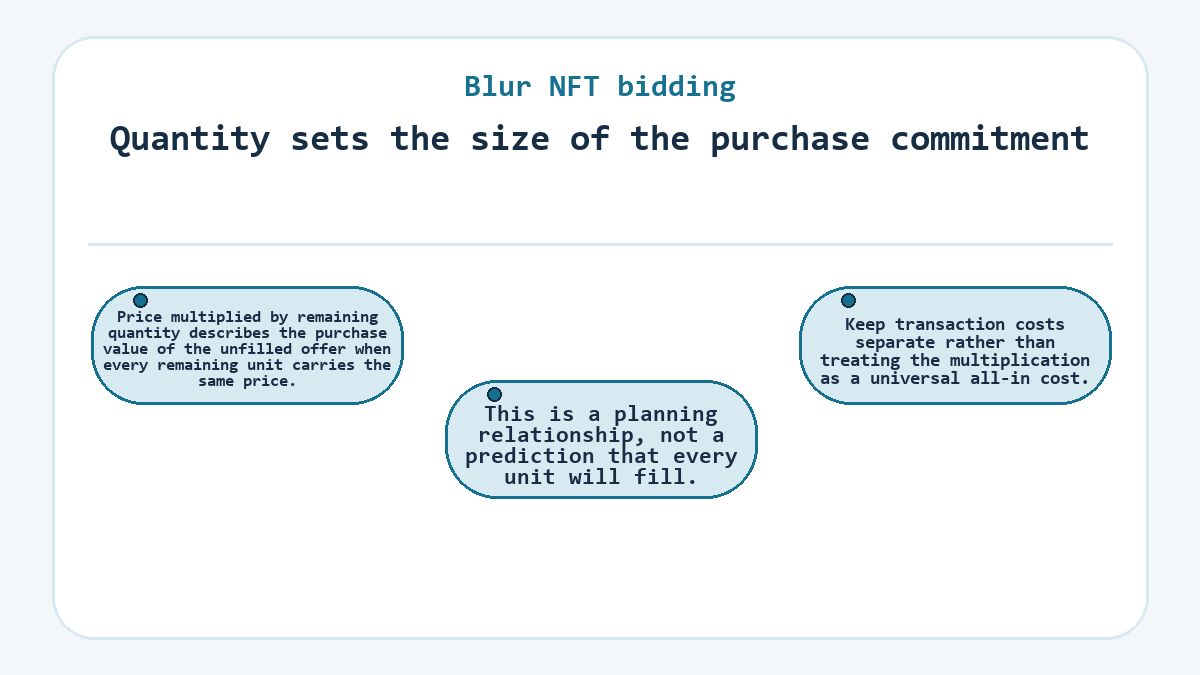
Can you choose which NFT a collection bid buys?
A collection bid leaves the seller to supply an eligible NFT, so it does not reserve your preferred item. Its breadth is the main trade-off: more items can satisfy the offer, while you give up item-by-item selection before settlement. An appealing collection image or a rare item you inspected does not narrow the signed offer.
Collection eligibility also does not promise resale demand, a particular appearance, or a favorable valuation. If your willingness to buy depends on a specific item, buying through that item's listing lets you select the NFT before purchase. A narrower offer only expresses that preference if its actual terms enforce the restriction. Browsing filters alone are not a substitute for matching offer criteria.
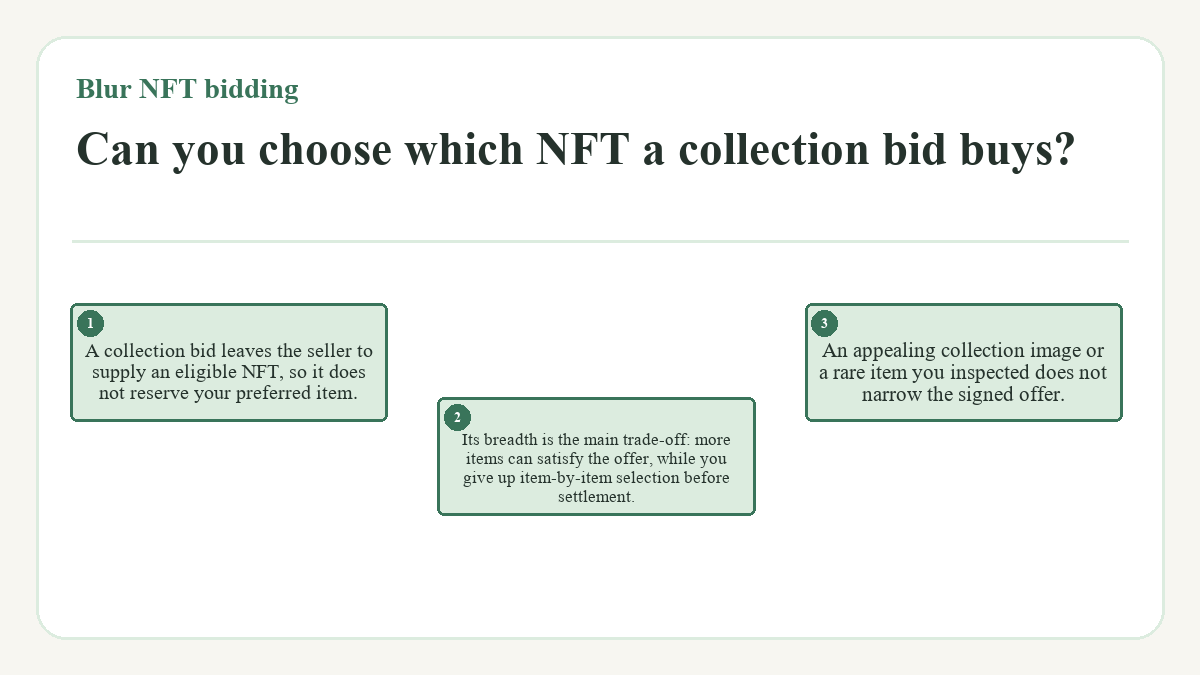
Quantity sets the size of the purchase commitment
Price multiplied by remaining quantity describes the purchase value of the unfilled offer when every remaining unit carries the same price. This is a planning relationship, not a prediction that every unit will fill. Keep transaction costs separate rather than treating the multiplication as a universal all-in cost.
Blur's V2 exchange tracks consumed quantity against an order's authorized amount, allowing an offer to remain partly unfilled. A partial fill therefore calls for a different decision than a completed offer: you already hold purchased NFTs while the remaining quantity can still expose you to additional purchases.
Several active offers deserve a combined view. Assess the purchases they collectively authorize, without assuming each displayed offer has a separate reserve of money.
Bidding funds and wallet funds have different roles
Blur's bidding pool records a deposited balance for each account. Depositing increases that balance, and withdrawing reduces it. Ordinary wallet funds and deposited bidding funds are separate balances, so a funded wallet alone does not establish that a collection bid can settle.
For V2 bid acceptance, the exchange takes payment from the bidder's pool balance. A deposit itself does not purchase an NFT. The purchase requires a successful fill, which changes both the payment balance and NFT ownership. Keep enough wallet funds for any on-chain transactions you submit, such as funding or withdrawing, rather than confusing those costs with the bid price.
A low balance is not a reliable record of cancellation. Funding and order validity are separate conditions; restoring funds can remove a funding obstacle while an otherwise valid offer remains outstanding.
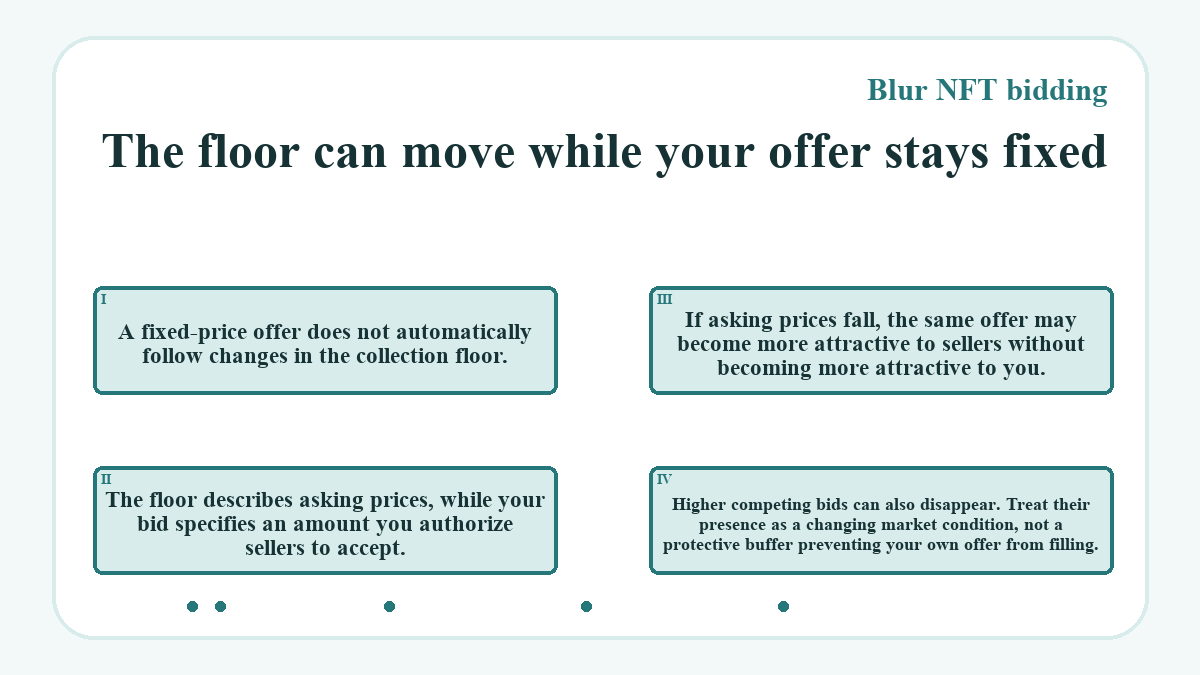
The floor can move while your offer stays fixed
A fixed-price offer does not automatically follow changes in the collection floor. The floor describes asking prices, while your bid specifies an amount you authorize sellers to accept. If asking prices fall, the same offer may become more attractive to sellers without becoming more attractive to you. Higher competing bids can also disappear. Treat their presence as a changing market condition, not a protective buffer preventing your own offer from filling.
How long can a collection bid remain available?
A collection bid can remain available until its expiration, provided sufficient quantity, funding, and valid authorization remain. Blur's V2 exchange rejects an order once its expiration time has arrived. The expiration belongs to the individual order; there is no universal duration to infer from the collection name. Expiration limits the opportunity for future fills and does not undo purchases completed earlier.
Cancel the remaining offer when your buying conditions change
Cancellation concerns the unfilled commitment, while withdrawal concerns money remaining in the bidding pool. The V2 exchange provides cancellation controls for order quantities and a broader nonce change that invalidates existing orders under that nonce. A broad cancellation can therefore affect more than the single collection offer you were considering.
Submitting a cancellation is not proof it took effect before a competing fill. Reconcile the final order state with any completed purchases, especially when sellers were accepting bids during the change. Closing a browser window does not invalidate signed terms.
Leave a collection offer active only while its eligible items, price, and remaining quantity still describe purchases you would accept. If your preference narrows to a particular NFT, the appropriate purchase method changes with that requirement.
Common questions about Blur NFT bidding
Does a gas-free bid signature authorize a real purchase?
A bid signature can authorize a purchase even when signing itself requires no network fee. The signature approves order terms the exchange can later validate during settlement. The absence of a gas charge does not make the offer a preview or a nonbinding expression of interest. Read the collection scope, price, quantity, and expiration before signing.
Why can a visible collection bid fail when a seller accepts it?
A visible bid can fail because its execution conditions no longer hold. Funding, expiration, consumed quantity, authorization, or the NFT transfer can prevent settlement. A displayed offer is not a reservation guaranteeing acceptance. The failure of one acceptance attempt also does not establish that the underlying offer has been permanently canceled.
Can an NFT without a sale listing fill my collection bid?
A seller does not need a separate asking-price listing to accept a compatible collection bid. The bid supplies the purchase terms for that transaction. The seller must still control an eligible NFT and authorize its transfer, and the bid must satisfy its execution conditions. Your potential purchase set therefore extends beyond the items currently advertised with asking prices.
Will raising my collection bid make a seller accept it?
Raising a bid changes the offered payment but does not compel a seller to accept. Sellers may retain their NFTs, prefer another offer, or encounter execution constraints. The higher price also changes what you authorize if acceptance occurs. Treat an increase as a revised purchase commitment, rather than a guaranteed way to complete a purchase.
Is placing a replacement bid proof that the previous bid has ended?
A new signed offer does not by itself prove the previous offer is invalid. Whether an editing action also cancels an earlier order depends on the action performed. Inspect both order states when replacing a bid. Otherwise, an older offer can remain relevant to your total purchasing exposure even after you have chosen different terms.
When does an unfilled bid create a trading loss?
An unfilled bid has not yet created a loss on an acquired NFT because no purchase has occurred through that bid. Funding, withdrawal, or on-chain cancellation transactions can still incur network costs. Once a fill occurs, the acquired item's resale value can differ from its purchase price, and selling it may introduce further costs.
Are bidding rewards a discount on the purchase commitment?
Bidding rewards do not reduce the price authorized in the offer. Any incentive program has its own eligibility and distribution terms, separate from settlement. A possible future reward should not be subtracted from the amount needed to fund an accepted bid. Historical reward rules also do not establish the terms of a later program.
Last updated: